NOCARD Base
A Database for Functional Annotation of Hypothetical Proteins in Nocardia asteroides
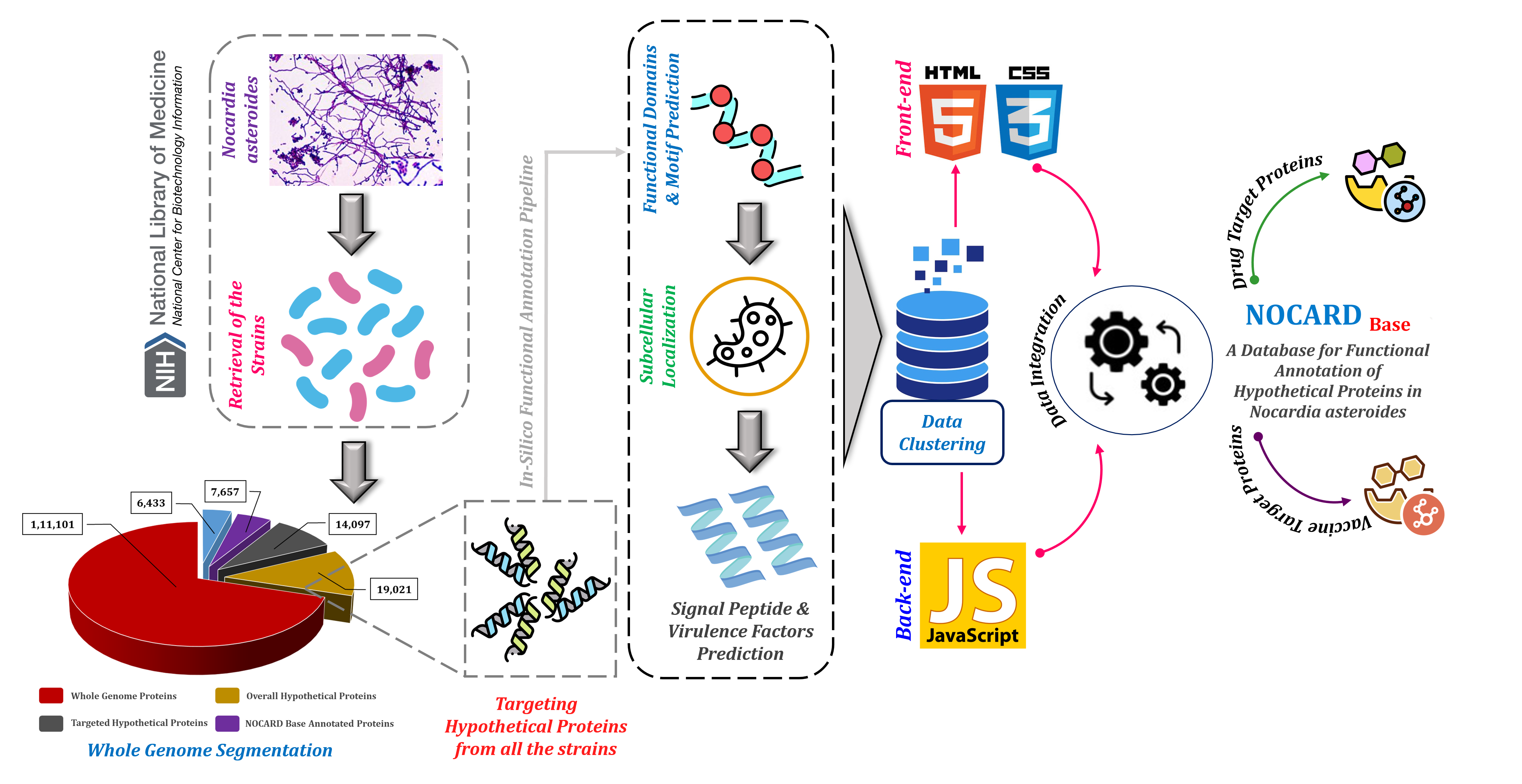
NOCARD Base is a comprehensive open-access database developed for the functional annotation of hypothetical proteins identified from pathogenic strains of Nocardia asteroides. The platform was designed to provide a dedicated and centralized resource for researchers working on nocardiosis, an important infectious disease caused by pathogenic Nocardia species. Since no specialized database currently exists for Nocardia asteroides, NOCARD Base aims to bridge this critical gap by offering systematically curated genomic and functional annotation datasets through an interactive and user-friendly platform. The database contains retrieved pathogenic strains of Nocardia asteroides, from which hypothetical proteins were identified and characterized using a comprehensive functional annotation pipeline [1]. The functionally annotated and characterized hypothetical proteins may possess unique functional, or pathogenic properties that could serve as potential drug targets, vaccine candidates, or biomarkers against nocardiosis, making them suitable for downstream computational analysis and experimental validation [2]. In addition to annotated hypothetical proteins, NOCARD Base also integrates a wide range of associated datasets including genomes, strains, bioassays, substances, BioProjects, BioSamples, patents, and related scientific books and resources. NOCARD Base serves as a valuable scientific resource for microbiologists, bioinformaticians, drug discovery researchers, and the broader scientific community by providing freely accessible data for advanced computational and translational research. The platform is dedicated to supporting future investigations aimed at identifying novel therapeutic interventions and improving our understanding of the pathogenic mechanisms of Nocardia asteroides.
Nocardia asteroides is a Gram-positive, aerobic, filamentous bacterium characterized by branching hyphae-like structures under microscopic observation. It is recognized as an important opportunistic and nosocomial pathogen capable of causing severe infections in humans, particularly among immunocompromised individuals and organ transplant recipients. Among the different species of Nocardia, N. asteroides is considered one of the most dominant and clinically significant pathogens associated with nocardiosis. The organism primarily causes pulmonary nocardiosis, which is commonly acquired through inhalation of contaminated particles into the respiratory tract. Clinical manifestations of infection include cough, chest pain, dyspnea, fever, fatigue, weight loss, and night sweats. Several of these symptoms closely resemble those observed in Tuberculosis (TB), making accurate pathogen detection and differential diagnosis essential for effective treatment [3]. In severe cases, the pathogen may disseminate to other organs, especially in patients with weakened immune systems. Nocardia asteroides belongs to the phylum Actinomycetes, a group of microorganisms known for producing diverse secondary metabolites, including clinically important antibiotics. Previous studies have demonstrated the remarkable virulence potential of Nocardia species due to their ability to survive and persist within various human cells. Furthermore, antimicrobial susceptibility patterns and pathogenic characteristics vary considerably among different Nocardia species, increasing the importance of species-specific characterization and analysis. Epidemiological studies indicate that nocardiosis predominantly affects individuals between 40 and 80 years of age, with the majority of reported infections occurring in immunocompromised populations, particularly in the United States and other developed regions worldwide [4].
1. In-silico structural and functional annotation of hypothetical proteins from Nocardia asteroides NCTC11293: A computational approach for novel drug target identification and therapeutic development
Maharaja M S, Manikandan J & Jeyakanthan J
Journal: Computers in Biology and Medicine
🔗
Access Article
2. Structural and functional insights into glycosyltransferase from Nocardia asteroides NCTC11293 and structure-guided discovery of marine and phytochemical leads through pharmacokinetic screening and molecular dynamics studies
Maharaja M S, Manikandan J, Prabhu D & Jeyakanthan J
Journal: Journal of Molecular Graphics and Modelling
🔗
Access Article
3. Nocardiosis: Updates and Clinical Overview
John W. Wilson MD
Journal: Mayo Clinic Proceedings
🔗
Access Article
4. Epidemiology of Nocardiosis -A six years study from Northern India
Reetika Dawar, Ruchi Girotra, Seema Quadri, Firdaus Imdadi, Leena Mendiratta, Hena Rani, Avdesh Bansal, Raman Sardana
Journal: Journal of Microbiology and Infectious Diseases
🔗
Access Article
5. Nocardiosis: A Neglected Disease
Shalini Dewan Duggal, Tulsi Das Chugh
Journal: Medical Principles and Practice
🔗
Access Article
6. The global epidemiology, risk factors, and mortality prediction of nocardiosis: an easily missed opportunistic infection
Bingqian Du, Ziyu Song, Zhiqiang Ren, Deming Tang, Jirao Shen, Jiang Yao, Xiaotong Qiu, Shuai Xu, Min Yuan, Zhiguo Liu & Zhenjun Li
Journal: Scientific Reports
🔗
Access Article